
Taricha rivularis - Cal Native Series
Taricha rivularis - Cal Native Series
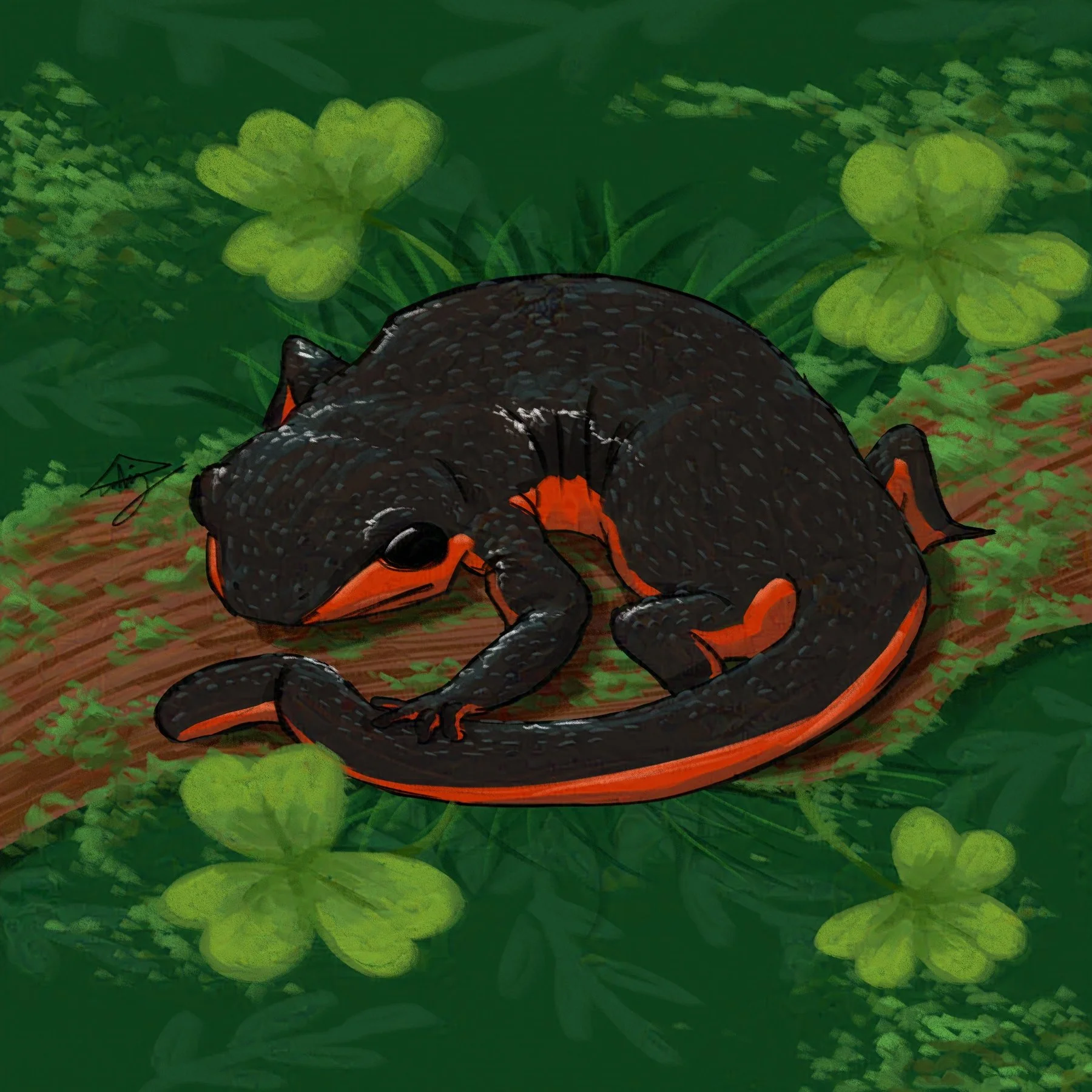
Red-bellied Newts, or Taricha rivularis, are a stocky salamander with a dark top and a bright reddish-orange bottom. Their eyes are solid black, which can help you differentiate them from other species of similar-looking newts found in California’s Coastal Redwoods(California Newts, Sierra Newts, and Rough-Skinned Newts)[1][6][9].
Interesting Toxicity fact:
Have you heard about the toxicity arms race between newts and Garter Snakes?
If not, basically it goes like this:
Garter snakes (genus Thamnophis) develop a hankering for a Taricha spp. newt snack.
The problem is newts in the genus Taricha are highly toxic. There is enough tetrodotoxin (TTX) in one newt to kill 20 human adults[1].
Despite garter snakes being 34 inches on average, they are highly resistant to this toxin and continue to snack[11][10]. For the snakes that are not immune, they die quickly, and so only the most resistant snakes live long enough to produce offspring, and the group doesn’t learn aversion to the newts.
A newt that isn’t deadly enough is far more likely to get eaten, so the most toxic newts reproduce.
And this keeps going round and round for millennia.
Actually, the most commonly thought of newt in this aspect is the rough-skinned newt, but the red-bellied newt is part of the same genus.
A bonus fact is that Red-bellied newts also have a terrestrial phase and an aquatic phase. They spend most of their adult life in terrestrial phase with rough skin, but when breeding they transition to a smoother aquatic phase[1].
Where to find it and my experience:
Red-bellied newts are endemic to California, meaning they live nowhere else in the world[8]. They populate two environments, just north of San Francisco in the Redwoods leading all the way up to Humboldt county, and the Santa Cruz Mountain Range in Santa Clara County[3][8]. These amphibians prefer cool, wet environments —think streams and creeks— and are found in coastal Redwood, Oak, and Douglas-fir forests[1][8].
I have come across newts before, although not this species specifically. Usually I try to only talk about species I’ve come across, so I have a personal story, but I have a plan on how I can add this one to my roster and how you can too.
In January or February, I will be starting up the hikes again (yesterday was the last one of the year) and will be on the lookout for salamanders at Sanborn county park. A friend has recommended this place before, but I haven’t struck out there quite yet, so I think this would be the perfect time to do so. My hope is the wetter season will make finding the terrestrial phase adults a lot easier. Best chance of spotting them, though, might be in March and April, when they are in their breeding season[6][8]. So keep an eye out at the beginning of the year, if you want to do a joint hike.
If you want to strike out on your own, you are likely to find juveniles under rocks in streams during the day, and the adults wandering the forest floor year-round [1][4][8]. These Salamanders can live around 20-30 years, so they’re there even if we can’t quite see them[1]. Wetter seasons are best for spotting. Also, Butano State Park in San Mateo County is apparently a hotspot, although I have not tested this myself[6].
Also, something that is very important is that any time you handle an amphibian, make sure you wear gloves. While this species of newt is highly toxic, that actually isn’t the main issue, unless you are licking your fingers. Instead, amphibians absorbs a lot through their skin, which can include creams, natural oils, or any sprays we apply to our hands, and can be harmed from direct contact. So be careful, and keep yourself and your non-human neighbor safe!
Today’s Art:
Today’s illustration was done in Clip Studio Paint and took me about 2 hours, give or take. I did something different this time and drew thumbnail sketches in preparation for the final piece. I’m trying to do those more to get more dynamic and fun poses for the future. Can you spot the pose I went with? Would you have liked to see another?
If you like what I do, please check out my website! Poke around and take a look at wildlife photos, past artworks, and my art shop to get something physical to celebrate some of your favorite species.
You can also reach out to me with your stories and comments and questions through my email. I had one subscriber tell me a really cool story about their recent encounter with a Garter Snake and I’d love to hear more!
weareecosystemengineers@gmail.com
Sources and more places to read here:
https://www.californiaherps.com/salamanders/pages/t.rivularis.html
https://esajournals.onlinelibrary.wiley.com/doi/abs/10.2307/1936504
https://www.inaturalist.org/observations?subview=map&taxon_id=27824
https://explorer.natureserve.org/Taxon/ELEMENT_GLOBAL.2.100208/Taricha_rivularis
https://wdfw.wa.gov/species-habitats/invasive/taricha-rivularis
https://www.savetheredwoods.org/explore/stories/newts-charismatic-creatures-of-the-redwood-forest/
https://www.proquest.com/openview/5cd4b5fa96e954c578daea22c32e92da/1?pq-origsite=gscholar&cbl=18750&diss=y
https://californiaherps.com/identification/salamandersid/newts.html
https://www.californiaherps.com/snakes/pages/t.s.fitchi.html
https://www.nps.gov/articles/000/common-garter-snake.htm
